

It was 1609, and Silvio Fiorillo, a forty-four-year-old actor from Capua, had already made a name for himself in many cities across northern and central Italy as Captain Matamoros, his signature role, much appreciated by the Gonzaga nobles. In addition to acting, he had also successfully dedicated himself to writing, authoring several works in his native Neapolitan language and in Tuscan.
That year, a comedy was published. It was destined to consign him to history when, in 1632, it was published in Milan, perhaps even posthumously: "La Lucilla costante con le ridicole disfide e prodezze di Policinella." For the first time, the character of Pulcinella appeared, having already been brought to the stage by Fiorillo, who has since been considered its father, at least in literary terms.
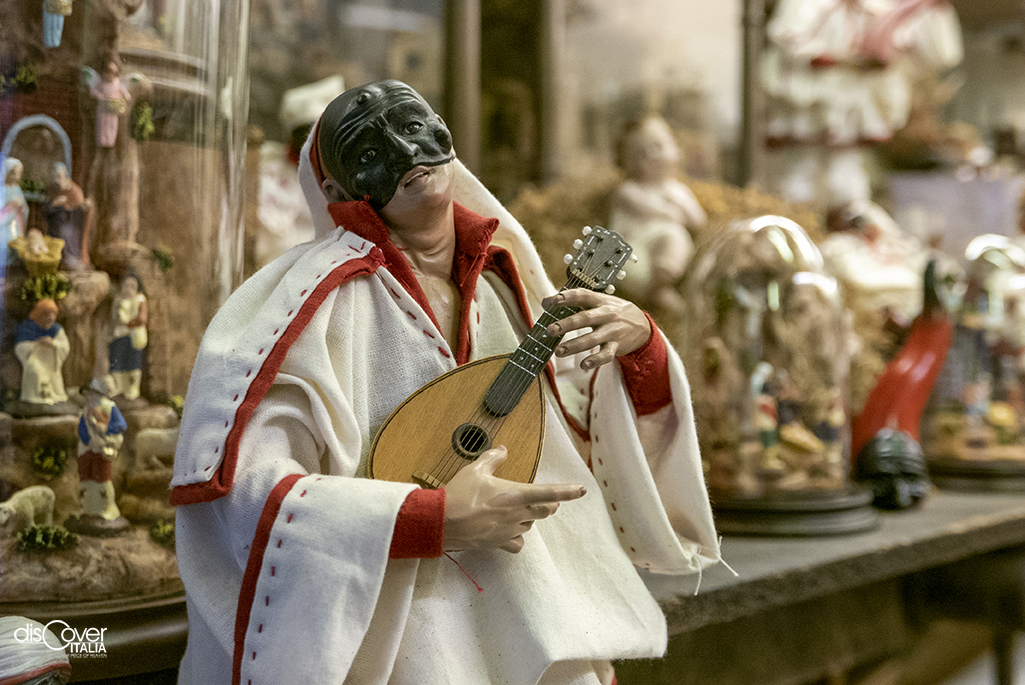
The inspiration for the Neapolitan mask is said to have come from a farmer from the Acerra countryside, Puccio D'Aniello. According to tradition, Puccio displayed such a satirical streak and improvisational ability during the visit of a theater company in Acerra that they invited him to perform with them. Some of the characteristics of Fiorillo's Pulcinella can be traced back to this origin, starting with the loose white shirt, the tanned face beneath the mask, and the prominent nose. It is a fact that Acerra claims to be the birthplace of Pulcinella, recognized worldwide as one of the symbols of Naples. Indeed, the city hosts the Museum of Pulcinella, Folklore, and Rural Culture in some rooms of its castle.
However, some studies on Pulcinella have identified an even more remote origin, linking it to the Fabula Atellana, the first form of satirical comedy, born in the Oscan language in the city of Atella (which, incidentally, is about twenty kilometers from Acerra), and then spreading throughout the Roman world from the 4th century BC. Among the fixed masks of the Atellana in every performance was Maccus, a foolish, gluttonous character, often beaten and mocked by others like Pulcinella. Other physical and clothing characteristics are similar: the double hump, a large nose, and the ever-present white tunic. Since the Atellana is considered the mother of the Commedia dell'Arte, Pulcinella seems to embody Maccus's heir, especially given that the two masks share the same birthplace.
However, it was one of his greatest historical interpreters on the stage, the Neapolitan actor and playwright Antonio Petito, who defined the character's characteristics as we know them today. Petito, who consecrated the character's Neapolitan nature, even playing him in the presence of King Vittorio Emanuele II. Followed in the footsteps of Salvatore, who also played "Pulecenella." Antonio also designed the Neapolitan character's stage attire: the loose-fitting white shirt and trousers, the white sugarloaf hat, unlike the original bicorne, and the black mask, marked by pronounced wrinkles, covering half of the face, finally "freed" from beard and moustache. From a personality standpoint, over time, Pulcinella has become synonymous with a lazy, cunning person, capable of getting by in any circumstance, ironic, chatty, irreverent even towards the establishment and yet servile, in love with food with a passion for "maccarune." Incapable of keeping a secret, so much so that the famous expression "it's Pulcinella's secret" has been borrowed to indicate what has become public knowledge.
Neapolitan theater character
After Fiorillo, Pulcinella was to establish himself as a key figure in Neapolitan comic theater in the centuries that followed. He was the protagonist of performances staged in a new theater dedicated to comedy, the San Carlino, built in 1740 near the church of San Giacomo degli Spagnoli, behind the Maschio Angioino and then rebuilt in 1770. The leading interpreters of the mask performed there, around which a vast repertoire had meanwhile developed. Among the most passionate spectators was Ferdinand IV, who had commissioned the reconstruction of the San Carlino, where he was not averse to attending Vincenzo Cammarano's Pulcinella performances.
Among the greatest interpreters of Pulcinella was Eduardo Scarpetta, who dedicated nine new plays to him. Another author who revisited and modernized the character of Pulcinella was Raffaele Viviani. In 1957, Eduardo De Filippo, who had acted in Scarpetta's plays as a young man, presented the play "Il figlio di Pulcinella."
Protagonist of the Teatro delle Guarrattelle
The seventeenth century, the official period of his literary birth, also saw Pulcinella become the inspiration and protagonist of a very popular form of performance in viceregal Naples: the Teatro delle Guarrattelle, or marionette and puppet theatre, in which the character is strongly characterized by his unmistakable voice, produced through a special instrument called a pivetta. For that form of performance, another equally extensive repertoire developed over time. It took the main features of the theatrical and literary character and adapted him to the needs of street performances and their particular audiences, even making him a voice against the authorities.
Pulcinella in Art
An iconic figure of Neapolitan culture, Pulcinella is also recognized as apotropaic ward against bad luck. His terracotta statuette is therefore considered a good-luck charm. Using the techniques used for shepherds, they are crafted by nativity scene artisans, particularly in the workshops of San Gregorio Armeno.
Pulcinella's allure has also inspired numerous artists over time. A bronze statue depicting his masked face is located in the heart of Naples, in Vico del Fico al Purgatorio, at the intersection with Via Tribunali. It is the work of artist Lello Esposito, who donated it to the city in 2012. It is said that touching his nose brings good luck...