


A large and prosperous city, considered second only to Rome, so much so that it earned the title "altera Roma", coined by Cicero in 73 BC.
As a testament to its importance, Capua already had a large amphitheater for gladiatorial games, which were becoming increasingly popular and followed by both patricians and plebeians. Precious remains of that original venue, built between 130 and 90 BC, have been unearthed in the area designated for the games since then, outside the city, near the Via Appia, the “regina viarum” that directly connected Capua to Rome. That ancient amphitheater was likely the first to be built in masonry in Roman times. It also housed the first gladiatorial school. Thus, among the many events to which it was a silent witness, we also remember the historic revolt of the gladiators led by Spartacus between 73 and 71 BC. That first amphitheater gave way, between the end of the 1st and the beginning of the 2nd century AD, in the midst of the Flavian era, to a new one, second in size only to the Colosseum, for which it may have been the model.
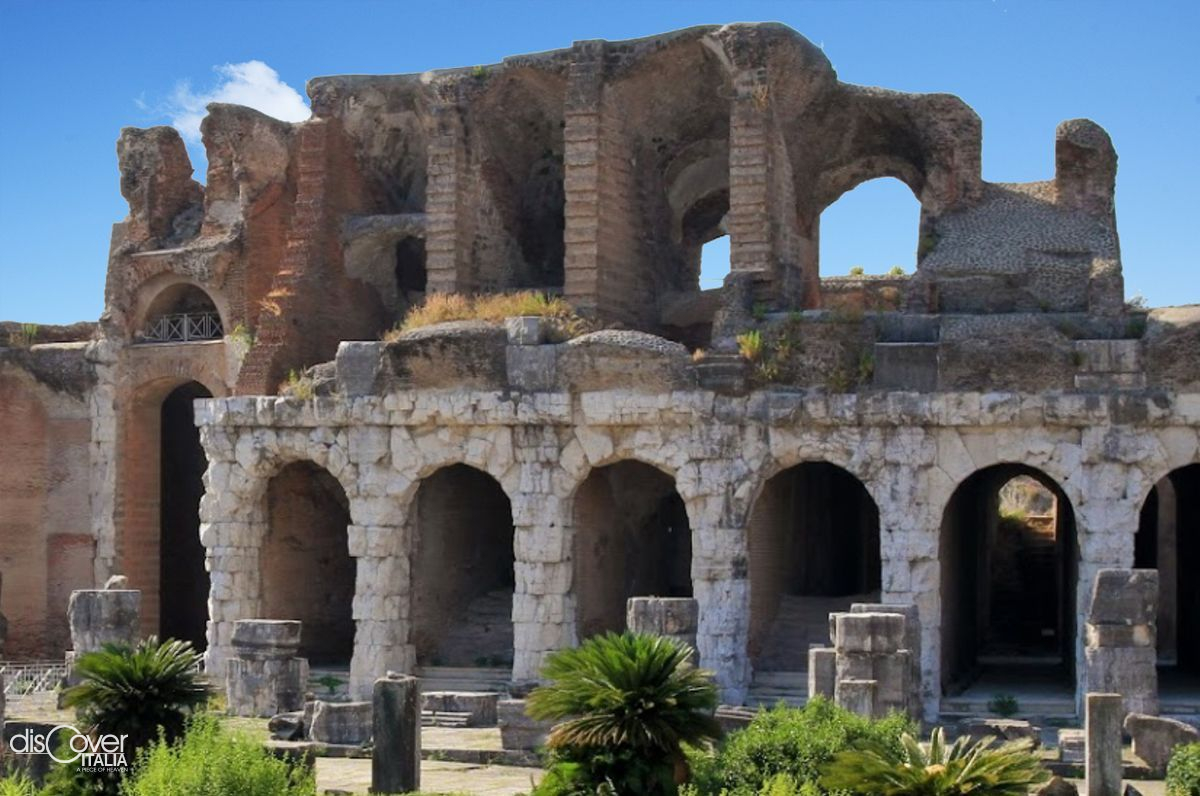
Elliptically shaped, the Capua amphitheater was colossal: the major axis measured 170 meters and the minor axis 139, a width that could accommodate up to sixty thousand spectators in the stands. It had four levels, corresponding to the ima, media, and summa cavea, and the attic. They were connected by internal and external staircases and large connecting galleries, for a total height of 46 meters. The three lower levels featured eighty travertine arches supported by Tuscan-style columns. The façade was sumptuously embellished by numerous marble busts of deities placed in the keystones. Today, seven of them adorn the façade of the Capua Town Hall, while others are on display in both the Capua Museum and the Museum of Santa Maria Capua Vetere. It was during eighteenth-century excavations in the amphitheater area that the famous Venus of Capua was discovered. It is now on display in the National Archaeological Museum of Naples. The top of the four floors, however, was punctuated by windows and pilasters and a cornice with brackets for the poles that supported the enormous awning. The vast underground rooms housed the complex stage machinery, sets, and stalls for the numerous animals typically used in the shows.
The stone giant had been built just a century before when Emperor Hadrian, in 119 AD, ordered its restoration, during which other statues and columns were added. However, it was not until 155 AD, under EmperorAntoninus Pius, that it was reopened. The amphitheater continued to function throughout the imperial period, although gladiatorial shows had been banned under Honorius. However, wild animal shows, known as “venationes”, continued. These events continued even after the fall of the Western Roman Empire, when the amphitheater suffered the destructive fury of Genseric's Vandals.
In the northwestern section of the underground passages, still accessible, a Christian oratorywas built around the 4th and 5th centuries. Traces of wall paintings and parts of the marble slabs from the floor and altar remain as evidence.
Another wave of destruction struck the Capuan amphitheater during the war of succession for the Duchy of Benevento in 841. It was the Saracens who then ravaged what remained of the ancient city and its most iconic monumental building, which was subjected to further outrage. Subsequently, the remaining ruins were chosen as a refuge by the few Capuans who chose not to move to Casilinum like the majority of their fellow citizens, who founded the new Capuathere. Beginning in the 9th century, the marble and most valuable materials from the ancient structure were systematically stolen and reused in Capua's new buildings, particularly the Norman castle, churches, and contemporary noble palaces.
It was 1726 when part of an epigraph crucial to reconstructing the building's history resurfaced in front of the southern gate of the ancient amphitheater. "Colonia Iulia Felix," as the inscription begins, was correctly integrated, reconstructing all the relevant information about its initial construction during the time of Hadrian and the restoration completed under Antoninus Pius. The inscription was completed by the great Capuan epigrapher Alessio Simmaco Mazzocchi, who quickly established himself as the foremost expert on the Campanian Amphitheater. That year officially marked therediscovery of the monument, which had long been forgotten. It was the subject of archaeological excavations, particularly in the 19th century, between 1811 and 1860, when most of the structures were unearthed. It was declared a national monument during the Bourbon era in 1822. Excavation activities continued through the 1920s and 1930s, when the restoration work was completed and the building's preservation began. It was opened to the public in 1913.



Comments powered by CComment